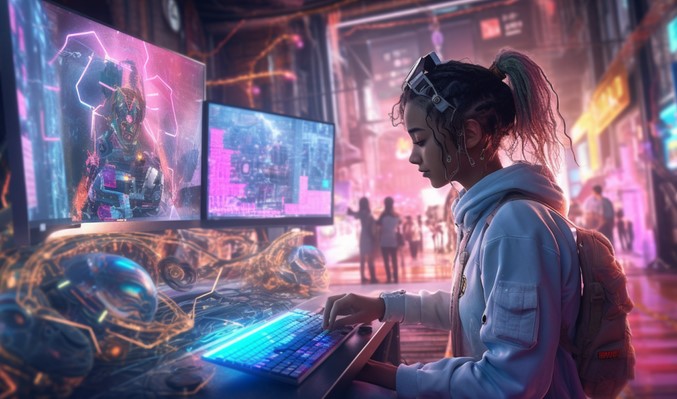
Imagine playing an open-world RPG where you decide to steal a loaf of bread from a street vendor. In a traditional game, the vendor might shout a canned line of dialogue or chase you for three blocks before resetting. But in the new era of play, that vendor remembers your face. Two days later, when you try to buy a life-saving potion, he refuses to sell to you, and the local guards are suddenly more suspicious of your presence. The world didn’t just “react”—it thought.
Over my decade in the tech trenches, I’ve spent a lot of time looking at how high-level algorithms can predict patient outcomes in HealthTech. However, my “after-hours” passion has always been observing how these same neural networks are migrating into our consoles and PCs. I remember sitting in a developer preview back in 2022, watching an NPC (Non-Player Character) navigate a complex environment without a single line of pre-written pathfinding code. It was the moment I realized AI for gaming was about to move from “scripted” to “sentient.”
If you think AI in games is just about enemies being harder to kill, you’re only seeing the tip of the iceberg. We are entering an age where the game learns from you just as much as you learn the game.
The Evolution of the “Brain” Behind the Controller
For years, “Game AI” was actually a bit of a misnomer. It wasn’t true intelligence; it was a Finite State Machine (FSM). Think of it like a flow chart: If player is in range, then attack. If health is low, then hide. ### The Dance Partner Analogy
Think of traditional game AI like a music box. No matter how many times you open it, the ballerina spins the exact same way. AI for gaming in 2026 is like a professional dance partner. If you lead with a new step, they adjust their weight, change their tempo, and follow your rhythm in real-time. It’s a living, breathing collaboration rather than a pre-recorded loop.
1. Transforming NPCs into Digital Individuals
The most visible impact of AI for gaming is in the characters we interact with. We are moving away from the “Question Mark over the head” era.
-
Generative Dialogue: Using Large Language Models (LLMs), developers are creating NPCs that can have unscripted conversations. You can actually speak into your headset, and the character will respond contextually to your specific words.
-
Behavioral Learning: Modern enemies use Reinforcement Learning. If you always use a sniper rifle from the same hill, the AI recognizes the pattern and sends a flanking squad to your exact coordinates.
-
Persistent Memory: Characters now possess “long-term memory” modules. Your reputation in a digital city isn’t just a bar on a UI; it’s a complex web of social data stored in the cloud.
2. Procedural Content Generation: Infinite Worlds
One of the biggest hurdles in game development is the “Cost of Content.” It takes thousands of hours to hand-draw a forest. With AI for gaming, we use PCG (Procedural Content Generation).
Instead of an artist placing every tree, they write a “DNA script.” The AI then uses that DNA to grow an entire planet. This isn’t just random generation; it’s intelligent generation. The AI ensures that a river flows downhill, that vegetation grows near water, and that the terrain is actually fun to navigate. This technology allows for games with near-infinite replayability.
3. The Technical Engine: Deep Learning Super Sampling (DLSS)
For the intermediate gamers interested in the “how,” we have to talk about hardware-level AI. If you’ve noticed your games looking sharper and running smoother lately, you likely have DLSS (from NVIDIA) or FSR (from AMD) to thank.
This is a form of Neural Rendering. The game renders at a lower resolution (to save your GPU’s energy) and then uses an AI “upscaler” to fill in the missing pixels. It’s like a world-class artist looking at a blurry sketch and instantly painting a masterpiece over it. In my technical opinion, this is the most significant hardware leap of the last decade, allowing mobile chips to produce “desktop-quality” visuals.
4. AI-Driven Anti-Cheat: The Silent Sentinel
In my years of auditing secure systems, I’ve learned that wherever there is a system, there is someone trying to break it. Cheating in online games is a multi-million dollar “dark industry.”
Traditional anti-cheat looks for “forbidden software” on your computer. Modern AI for gaming anti-cheat looks for inhuman patterns. It analyzes the “aiming arc” of a player. If a player’s crosshair moves with a mathematical perfection that exceeds human motor skills, the AI flags them instantly. It doesn’t need to find the “cheat file”; it just needs to see the “cheat behavior.”
5. Expert Advice: The “Hidden Warning” for Players
While AI makes games more immersive, there is a technical trade-off that rarely gets discussed in marketing brochures.
Tips Pro: AI-driven games require a constant “handshake” with the cloud. If you are playing a game that features generative AI dialogue or complex cloud-based pathfinding, your Latency (Ping) matters more than your GPU. A slow internet connection can make a “smart” NPC act very “stupid.”
Beware of AI Hallucinations in games. Sometimes, generative AI can break the “immersion” by mentioning things that don’t exist in the game world. If an NPC starts talking about the “real world” or breaks character, it’s a sign that the AI’s “constraints” (the guardrails) are too loose.
6. How AI is Personalizing Your Difficulty
Have you ever played a game that felt “just right”—not too easy, but not frustrating? You might have been experiencing Dynamic Difficulty Adjustment (DDA).
AI for gaming monitors your “vitals” (your heart rate if you’re wearing a smartwatch, or your input speed). If the AI sees you are failing at a boss fight for the tenth time, it doesn’t just lower the enemy’s health. It might subtly change the enemy’s “aggression logic” to give you a narrow window of opportunity. It “curates” the thrill so you stay in the Flow State—that magical zone where time disappears and you are perfectly engaged.
Summary: The End of the “Pre-Scripted” Era
We are standing at a crossroads. For thirty years, gaming has been about mastering a set of rules designed by a human. With AI for gaming, we are entering an era where the rules are fluid, the characters are unique, and no two players will ever have the same experience.
As someone who has seen tech transform the way we save lives in hospitals, I find it incredibly inspiring to see it now transforming how we live those lives through play. The line between “simulation” and “reality” isn’t just blurring; it’s being rewritten by intelligence.
Is the AI getting too smart?
We are reaching a point where an NPC might feel like a real friend—or a very real enemy. Do you prefer a game that follows a strict, well-written script, or are you excited about a world that learns and changes based on your every move? Drop a comment below and let’s talk about the future of the digital playground!
