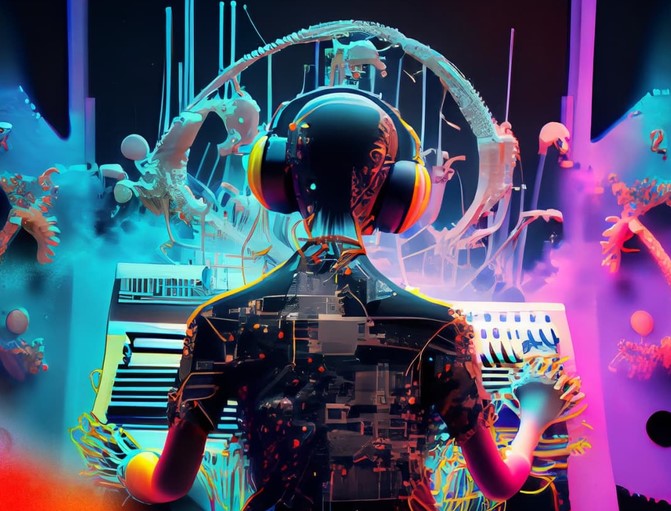
You are staring at a completely blank Digital Audio Workstation (DAW) screen. The cursor blinks rhythmically, almost mockingly, as the clock ticks past 2:00 AM. You have a brilliant concept for a melody floating inside your head, but your fingers refuse to translate it onto the MIDI keyboard. Writer’s block is frustrating enough for traditional writers, but for musicians, creators, and developers, “sonic block” can stall a massive project for weeks.
During my ten years deploying complex software pipelines and researching adaptive algorithms in the HealthTech and software sectors, I have spent a lot of time analyzing how technology interacts with human behavior. I remember sitting down with a team of developers who were building a therapeutic soundscape app designed to lower patient anxiety levels in real-time. We quickly realized that manual composition simply couldn’t keep up with the fluctuating biometric data of the patients. The solution wasn’t to hire an army of around-the-clock composers; it was to lean heavily into ai powered music composition.
That project shifted my perspective forever. AI isn’t here to replace the human soul or the emotional depth of a musician. Instead, it serves as the ultimate collaborative catalyst, turning the friction of composition into fluid experimentation. Let’s explore how this technology actually works and how you can use it to supercharge your creative workflow.
What is AI Powered Music Composition and How Does It Work?
To understand how ai powered music composition functions under the hood, think of the AI as the world’s most well-read musical intern. This intern has listened to every single piece of music ever recorded—from Bach’s intricate fugues to modern synth-heavy lo-fi hip-hop tracks.
The system relies on deep learning architectures, specifically generative adversarial networks (GANs) and transformer models (similar architectures to the ones powering modern language models). By processing millions of pages of sheet music and audio files, the AI learns the complex mathematical relationships behind chord progressions, rhythm structures, time signatures, and key changes.
When you type a prompt or tweak a parameter, you aren’t asking the machine to create magic out of thin air. You are asking it to look at its massive library of learned human patterns and suggest the next logical, beautiful musical phrase.
From Data to Desktop: The Modern AI Music Toolkit
The landscape of ai powered music composition tools has exploded, catering to different styles of production, content creation, and development workflows.
1. The Generative Songwriters
Platforms like Suno, Udio, and AIVA allow users to generate full-length instrumental or vocal tracks from simple text descriptions. You input a mood, a genre, and a tempo, and the system outputs a complete, layered arrangement in seconds. These tools are incredibly powerful for content creators who need custom, royalty-free background tracks for videos without spending thousands of dollars on licensing.
2. The MIDI Assistants and DAW Plugins
If you are an intermediate producer who wants to retain absolute control over your mix, you don’t want a machine to hand you a finished audio file. You want structural building blocks. Tools like Orb Producer, Captain Plugins, or Google’s Magenta project act as direct extensions of your creativity inside your DAW. They generate MIDI data—the digital blueprints of notes—allowing you to alter the instrumentation, swap out the synths, and rewrite the melodies manually.
The Creative Symbiosis: Why Artists are Embracing AI
There is a massive misconception that automated composition will render human musicians obsolete. In practice, the opposite is happening. Artists are utilizing these systems to bypass the tedious aspects of production.
-
Instant Prototyping: Instead of spending three hours building a basic drum loop and bassline to test a vocal melody, you can generate a structural backing track in thirty seconds to see if your vocal idea works.
-
Escaping the Cliche: Human brains are wired to fall back on comfortable habits. If you play the guitar, your hands naturally slide into the same four chords you always play. An AI engine doesn’t have muscle memory; it can throw a completely unexpected minor chord into your bridge, forcing you out of your creative comfort zone.
Step-by-Step Guide: Your First AI-Assisted Track
If you are ready to experiment with ai powered music composition, you do not need to know how to code. Follow this streamlined workflow to blend technology with your own personal taste.
1. Define Your Sonic Architecture
Start by establishing your constraints. Pick a target BPM (Beats Per Minute), a general mood (e.g., “melancholic cyberpunk” or “uplifting cinematic”), and your foundational instruments.
2. Generate the Structural Backbone
Use a generative tool to create a few distinct variations of a 4-bar chord progression. Look for something that catches your ear, even if it isn’t perfect yet.
3. Extract and Refine the MIDI Data
Import the generated MIDI file into your favorite DAW (like Ableton, FL Studio, or Logic Pro). This is where your human intuition takes the wheel. Slice up the progression, mute the notes that feel too cluttered, and add your own human touch by adjusting the note velocities to make the performance sound natural rather than robotic.
Balancing the Mix: The Human vs. AI Workflow
| Composition Stage | What the AI Does Best | Where the Human Must Step In |
| Ideation & Brainstorming | Generates dozens of chord variations instantly. | Selecting the core emotional theme. |
| Arrangement & Layering | Fills out background textures and harmonies. | Structuring the narrative flow and dynamic build-ups. |
| Mixing & Fine-Tuning | Automates frequency leveling and basic EQ. | Infusing subtle imperfection, soul, and final artistic intent. |
The Intellectual Property and Quality Traps
As powerful as this technology is, navigating it safely requires an understanding of a few distinct industry realities.
The Copyright Conundrum
The legal landscape surrounding generative art is evolving rapidly. Many platforms grant you a commercial license to use the music you generate on their servers, but you cannot legally copyright an AI-generated track in the exact same way you would a completely human-made song. If you plan to release music on major streaming platforms, always ensure you are heavily altering, mixing, and building upon the AI’s base output to make it truly your own distinct intellectual property.
The “Sausage Factory” Audio Bottleneck
Purely generative AI models output highly compressed, flattened audio files. If you listen closely to the high frequencies—like cymbals or delicate vocal reverbs—you will often hear a watery, digital swirling effect known as phase artifacting.
Pro Tip: Never use raw, unedited AI audio files as the main focal point of a professional commercial mix. Use them as background layers, or better yet, use the AI for its compositional data (MIDI) and run that data through high-quality, professional virtual instruments (VSTs) inside your DAW for pristine audio clarity.
Conclusion: The New Era of the Infinite Canvas
Ultimately, ai powered music composition is not a threat to human expression—it is an expansion of it. Technology has always reshaped art, from the invention of the electric guitar to the birth of the synthesizer. AI is simply the next evolution, acting as an infinite mirror that reflects human creativity back at us in unexpected, inspiring ways. The machine provides the data, but you provide the soul.
Are you ready to experiment with an AI co-writer in your next project, or do you prefer the tactile experience of traditional songwriting? What part of the modern production workflow takes up too much of your time? Let me know your thoughts in the comments below, and let’s discuss the future of sound!
