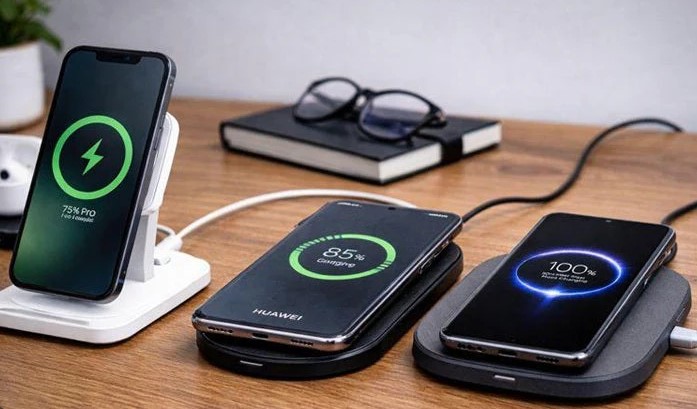
You are rushing to pack your bags for an early morning flight, or perhaps navigating a chaotic day of back-to-back meetings. You reach into your pocket to grab your wireless earbuds, only to find them completely dead. You look down at your desk, greeted by a tangled, frustrating web of Lightning cables, USB-C cords, and micro-USB bricks, none of which seem to be the one you need right now.
A few years ago, my tech gear bag weighed almost five pounds, stuffed entirely with varying charging cables for my phone, watch, and audio gear. Today, my travel setup is dramatically simpler. I carry a single sleek pad, and the moment I sit down, I drop my phone and my earbuds down with a satisfying magnetic click.
Having spent over a decade analyzing consumer electronics and testing battery hardware, I have watched power delivery transform from a clumsy physical necessity into an elegant, background utility. In 2026, the humble wireless charging case has shifted from a premium, optional luxury into an absolute staple of the modern mobile lifestyle.
Whether you are tired of dealing with frayed cables or curious about how safe this technology actually is for your expensive gadgets, let’s explore the world of cable-free power delivery.
The Invisible Bridge: How Cordless Power Works
To understand how a wireless charging case can juice up your devices without a single physical wire touching the battery, let’s use a simple analogy. Think of wireless power like singing a specific song to make a glass cup vibrate across the room.
The charging pad on your desk contains a tiny internal transmitter coil made of copper. When plugged into the wall, it starts “singing” an invisible song in the form of a high-frequency magnetic field.
Inside your device’s case, there is a matching receiver coil. The moment you place the case onto the pad, its coil hears that magnetic song and automatically starts vibrating with electrical current. This process is technically known as inductive charging, and it seamlessly converts that magnetic whisper back into pure electricity to top up your battery cell.
Why the Move to a Wireless Charging Case is a Game-Changer
For beginners and intermediate tech users alike, the benefits of upgrading your gear to wireless-enabled enclosures go far beyond just looking futuristic. It fundamentally alters how you maintain your devices.
1. Eliminating Hardware Failure Points
The most common hardware failure I have observed over my ten years in tech isn’t broken screens or corrupted software—it is ruined physical charging ports. Lint from your pockets gets jammed inside, or constant plugging and unplugging wears down the internal metal pins. Moving to a wireless system entirely removes this physical wear and tear.
2. Universal Ecosystem Harmony
For a long time, the tech industry was deeply fragmented by proprietary cables. Today, the world has largely unified around global wireless standards. A single high-quality wireless pad on your nightstand can now charge an Apple device, a Samsung phone, and a premium pair of Sony earbuds without needing a single adapter switch.
3. Smart Power Top-Ups
With standard cables, we tend to wait until our devices hit a critical 10% battery warning before hunting down a cord. A wireless setup encourages a healthier habit: micro-charging. By dropping your case onto a pad while you grab a coffee or reply to an email, your gear is constantly topped up in short, stress-free bursts throughout the day.
+-------------------------+-----------------------------------+-----------------------------------+
| Charging Attribute      | Wired Cable Connection            | Wireless Charging Case            |
+-------------------------+-----------------------------------+-----------------------------------+
| **Physical Wear**       | High (Frayed cables, bent pins)   | Zero (No moving parts or ports)   |
| **Convenience**         | Low (Requires two hands to plug)  | High (Drop-and-go interaction)    |
| **Device Alignment**    | Automatic (Forced by the plug)    | Critical (Needs proper centering) |
+-------------------------+-----------------------------------+-----------------------------------+
Navigating the Tech Jargon: Qi vs. Qi2 and MagSafe
When shopping for a new smartphone or audio accessory, you will run into a wall of technical acronyms. Let’s demystify exactly what you are paying for so you can shop with confidence.
The Baseline: The Qi Standard
Pronounced “chee,” this is the open, global foundation for wireless power transfer used by nearly every major electronics manufacturer. Traditional Qi charging works wonderfully, but it requires you to align your device perfectly over the center of the charging pad. If your cat bumps your nightstand at midnight, your device might shift slightly and fail to charge by morning.
The Upgrade: MagSafe and Qi2 Evolution
To solve the alignment issue, magnetic charging architectures were born. In 2026, the new Qi2 standard has brought magnetic alignment to both Android and Apple devices globally.
These cases feature a ring of integrated magnets embedded around the internal charging coil. The moment you bring your wireless charging case near a compatible pad, it snaps into the absolute perfect position with satisfying force. This perfect alignment prevents energy wastage, dramatically reduces heat, and allows for much faster charging speeds.
Insider Insights: Protecting Your Battery Long-Term
💡 Pro Tip: Ditch the Ultra-Thick Protective Cases
If you purchase a protective rugged cover for your wireless case, ensure it is labeled as MagSafe or Qi2 compatible. If the protective plastic layer is thicker than 3mm to 4mm, or if it contains decorative metal flakes, it will act as an insulating blanket. This forces the internal coils to work significantly harder, creating excessive heat and lowering your charging efficiency.
The most common concern I hear from readers is: “Does wireless charging ruin my battery health?”
The short answer is no, but with a major caveat. The ultimate enemy of any lithium-ion battery cell is excessive heat. Because inductive charging creates a small amount of ambient heat as energy transfers through the air, cheap, uncertified charging pads can cook your device over time.
To protect your investments, always buy power accessories from reputable, certified brands that feature built-in thermal throttling mechanisms and automatic shut-off safety overrides.
Streamlining Your Everyday Carry
We live in a world where our daily devices are meant to serve us, not tie us down to the nearest wall outlet. Transitioning your primary accessories—whether it is your smartphone, your smartwatch, or your daily earbud setup—to a system supported by a wireless charging case is an investment in personal efficiency.
It removes the subtle, daily friction of hunting down cables and managing battery anxiety. By relying on a streamlined, drop-and-go ecosystem, your devices seamlessly recharge themselves in the background of your life, ensuring they are always ready to perform the moment you need them.
What’s Your Workspace Setup?
Are you still holding onto your traditional wired chargers, or have you already transitioned your desk to a completely wireless layout? Have you checked if your current earbud or phone case supports magnetic alignment? Let me know your thoughts and drop your hardware questions in the comments below—let’s build your perfect cable-free setup!


 A few years ago, I sat in a crowded hospital waiting room, watching a frantic nurse juggle a stack of paper charts while trying to comfort a visibly distressed patient. It was a classic scene of healthcare gridlock—brilliant medical minds bogged down by administrative quicksand. Fast forward to today, and that same hospital is triaging patients using smartphones.