Picture this: You are watching a classic sci-fi movie where a captain steps onto a glowing platform, dematerializes in a flash of light, and rematerializes on an alien planet light-years away. For decades, pop culture has taught us that quantum teleportation is nothing more than a futuristic magic trick used to beam people across the cosmos in the blink of an eye.
When I first started covering emerging tech and quantum information science over a decade ago, physicists would roll their eyes whenever media outlets threw around the word “teleportation.” Back then, trapping a single photon in an entangled state felt like keeping a wild butterfly inside a hurricane.
Fast forward to today, and quantum teleportation is no longer confined to academic thought experiments or Hollywood scripts. It is a rapidly maturing, mathematically proven protocol that forms the backbone of the upcoming quantum internet.
Here is a deep dive into what quantum teleportation actually is, how it works under the hood, and why it is set to redefine modern data security.
What Is Quantum Teleportation (And What It Isn’t)
Let us clear up the biggest misconception right out of the gate: quantum teleportation does not move physical matter. You will not be beaming yourself to a beach in Bali anytime soon, and you definitely cannot send a physical smartphone across the room through thin air.
Instead, quantum teleportation is the instantaneous transfer of quantum information (the exact state of a particle) from one location to another, using quantum entanglement and a classical communication channel.
To understand this, think of it like an advanced cryptographic fax machine:
-
The original paper (the physical particle at the starting point) is destroyed or altered in the process.
-
An exact replica is printed out on the receiving end.
-
However, the data itself never actually “travels” across the physical space between point A and point B like an email packet traveling down a fiber-optic cable.
The Core Mechanics: How It Actually Works
To make sense of how physicists achieve this phenomenon, we have to look at the microscopic building blocks of quantum mechanics. Three fundamental principles make quantum teleportation possible:
┌───────────────────────────────────────────────────────────┐
│               QUANTUM TELEPORTATION PIPELINE              │
├──────────────────────────┬────────────────────────────────┤
│ 1. Entanglement Setup    │ Creating a shared Bell pair    │
│ 2. Joint Measurement     │ Bell State Measurement at Alice│
│ 3. Classical Transmission│ Sending 2 bits of normal data  │
│ 4. State Reconstruction  │ Applying unitary correction    │
└──────────────────────────┴────────────────────────────────┘
1. Quantum Entanglement: Spooky Action at a Distance
Albert Einstein famously dubbed entanglement “spooky action at a distance” because it baffled classical physics. When two particles become entangled, their quantum states are inextricably linked—regardless of whether they are sitting side-by-side in a laboratory or sitting on opposite sides of the planet. If you measure the spin or photon polarization of one particle, the state of its entangled partner is determined instantly.
2. Superposition and Qubits
Unlike classical bits, which can only be a strict
0 or 1, a qubit (quantum bit) can exist in a superposition of both states simultaneously. This massive data density allows quantum systems to process incredibly complex states that mirror reality far better than binary code.3. The Bell State Measurement and Classical Channel
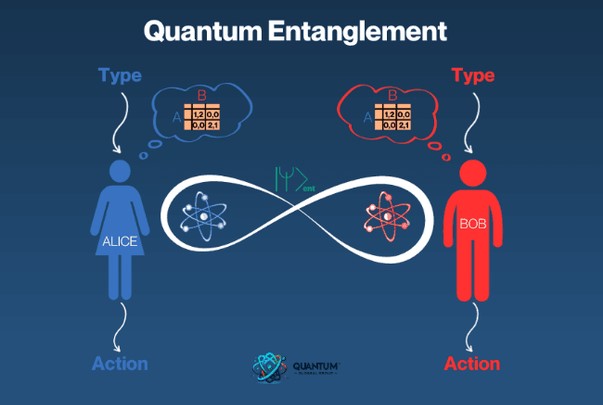
To teleport a quantum state from point A (Alice) to point B (Bob), Alice performs a Bell state measurement on her particle and her half of the entangled pair. This action collapses the state, destroying Alice’s original data but encoding instructions into two classical bits. Alice then sends these two bits to Bob over a normal internet connection, allowing Bob to apply the correct transformation to his particle and recreate the original state perfectly.
Why Quantum Teleportation Matters for the Future
You might wonder why scientists spend billions of dollars on a complex teleportation protocol when fiber-optic cables already move data at near-light speed. The answer comes down to security and network architecture.
-
Unhackable Networks: Because the quantum state is fragile, any attempt by a hacker to intercept or measure data in transit alters the state instantly, alerting both parties and destroying the intercepted data.
-
Distributed Quantum Computing: Future supercomputers will be too powerful and heat-sensitive to run as single monolithic blocks. Quantum teleportation allows multiple smaller quantum processors to link together seamlessly across cities without signal loss.
Technical Comparison: Classical vs. Quantum Data Transfer
| Feature | Classical Data Transfer | Quantum Teleportation |
| Medium | Copper cables, fiber optics, radio waves | Entangled particle pairs + classical channel |
| Data Unit | Standard Bits ($0$ or $1$) | Qubits in Superposition |
| Security Risk | Vulnerable to passive wiretapping | Inherently secure via quantum mechanics |
| Distance Limit | Signal attenuation requires amplifiers | Requires quantum repeaters to scale |
Pro-Tips & Hidden Caveats from a Tech Veteran
If you are diving deeper into quantum technologies, keep these vital realities in mind:
💡 Pro Tip: Respect the Speed Limit of the Universe
It is a common myth that quantum teleportation breaks Einstein’s speed-of-light limit. Because the final step requires sending standard classical bits (via ordinary radio or light signals) to tell the receiver how to reconstruct the particle, no useful information can travel faster than the speed of light.
⚠️ Hidden Caveat: The Fragility of Decoherence
The biggest enemy in quantum engineering is decoherence. Stray magnetic fields, ambient thermal heat, and microscopic vibrations can cause entangled particles to lose their fragile state before a teleportation circuit completes. This is why quantum hardware must be housed in extreme cryogenic dilution refrigerators operating close to absolute zero.
The Dawn of the Quantum Era
We are living through a historic transition period where theoretical physics is rapidly turning into applied engineering. While commercial quantum teleportation won’t replace your home Wi-Fi tomorrow, it is actively laying the foundation for a hyper-secure, interconnected quantum web that will redefine global communications.
Join the Conversation
Do you think a global quantum internet will become a reality within the next decade, or are the hardware hurdles of entanglement too steep to scale? Drop your thoughts and questions in the comments below! Let’s discuss where the future of computing is heading.

Comments are closed.