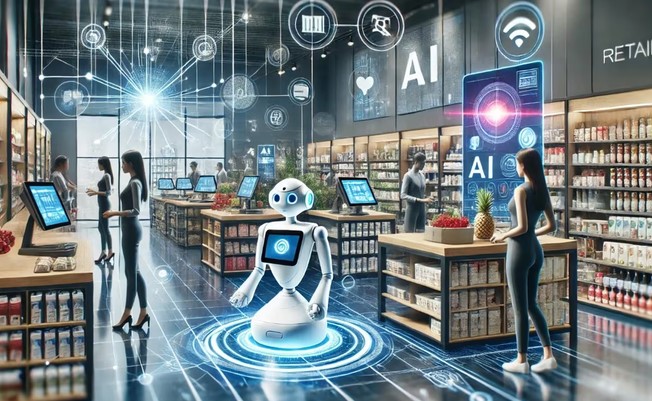
A few years ago, while consulting on an intelligent inventory and customer experience architecture for a health tech and smart retail crossover client, I experienced a moment that completely redefined my view of modern shopping.
I walked past a flagship store in downtown Chicago. Within seconds of browsing a digital kiosk, the screen suggested a specific set of ergonomic footwear tailored to my walking posture—derived from subtle pressure sensors under the floor mat—and offered a discount on a joint-health supplement I had researched online three days prior. It wasn’t magic. It was a seamless integration of computer vision, real-time analytics, and predictive AI working in perfect harmony.
For years, retail executives treated artificial intelligence as a futuristic gimmick reserved for tech giants. Today, AI in the retail industry is no longer a luxury—it is the baseline expectation for survival.
If you are a store owner, digital strategist, or tech enthusiast looking to understand how machine intelligence is reshaping shopping, this deep-dive guide breaks down the technology, strategies, and real-world execution without the overwhelming jargon.
1. How AI in Retail Industry Works: The Digital Concierge Analogy
To understand how AI in the retail industry transforms shopping, let’s use a simple analogy.
Imagine walking into a high-end boutique where the store manager has known you for twenty years. They know your size, your favorite colors, your budget, and even that you tend to buy gifts for your spouse every September. Now, imagine scaling that attentive manager to handle two million customers simultaneously, 24/7, across physical stores and mobile apps.
That digital concierge is artificial intelligence.
                                  +-------------------------------------------------+
                                  |              RETAIL DATA ENGINE                 |
                                  |   (Browsing, Purchase History, Store Footfall)  |
                                  +-------------------------------------------------+
                                                           |
                                                           v
       +---------------------------------------------------+---------------------------------------------------+
       |                                                                                                       |
[ ONLINE PERSONALIZATION ]                                                                          [ PHYSICAL STORE INFRASTRUCTURE ]
  - Machine Learning Recommenders                                                                     - Computer Vision & Smart Cameras
  - Dynamic Pricing Algorithms                                                                        - RFID & IoT Inventory Sensors
  - Generative AI Chatbots                                                                            - Heatmap & Footfall Analytics
       |                                                                                                       |
       +---------------------------------------------------+---------------------------------------------------+
                                                           |
                                                           v
                                  +-------------------------------------------------+
                                  |          HYPER-PERSONALIZED SHOPPER             |
                                  |                  EXPERIENCE                     |
                                  +-------------------------------------------------+
In modern enterprise retail, artificial intelligence acts as the brain connecting vast pools of raw data to tangible customer touchpoints:
-
Machine Learning Algorithms: Analyze patterns in historical purchase data to predict future demand and individual shopping behavior.
-
Computer Vision: Enables cameras to “see” inventory levels on shelves, track foot traffic, and facilitate checkout-free physical stores.
-
Natural Language Processing (NLP): Powers conversational AI assistants that understand context, tone, and user intent rather than relying on rigid menu scripts.
2. Personalization at Scale: Beyond “Customers Who Bought This Also Bought…”
Remember when online shopping recommendations were laughably basic? If you bought a lawnmower, the website spent the next three months showing you… more lawnmowers.
During my decade bridging health technologies and consumer platforms, I watched how machine learning algorithms evolved from basic collaborative filtering to complex predictive analytics.
Today, adoption of AI in the retail industry allows algorithms to process real-time contextual signals: local weather, time of day, current browsing speed, and social media trends.
Hyper-Personalized Product Recommendations
Modern recommendation engines do not just look at past transactions; they evaluate intent.
-
If a customer searches for organic vitamin supplements, an AI model connects high-intent health signals to recommend complimentary wellness products in real-time.
-
This level of hyper-personalization boosts cross-selling conversion rates by up to 30% while making shoppers feel truly understood.
Generative AI Shopping Assistants
Static search bars are disappearing. Customers no longer want to type exact keywords like “blue cotton running socks size 10.”
Instead, shoppers use natural prompts: “I’m going hiking in humid weather next week and need light gear for sensitive skin.” Generative AI models parse this query, search product catalogs, verify stock, and explain why specific recommendations match the request.
Pro Tip from the Field: When implementing AI search assistants, never leave the model ungrounded. Connect your Generative AI models directly to your real-time Enterprise Resource Planning (ERP) and Customer Data Platform (CDP) systems. An intelligent response recommending an out-of-stock product destroys customer trust faster than no recommendation at all.
3. Transforming the Physical Store: Smart Shelves, Computer Vision, and Phygital Retail
One of the biggest misconceptions I encounter is that AI is strictly an e-commerce tool. In reality, brick-and-mortar stores are undergoing their biggest revolution since the invention of the barcode.
The term “Phygital”—the blending of physical shopping environments with digital intelligence—is powered entirely by artificial intelligence and Internet of Things (IoT) sensors.
+--------------------------+------------------------------------------+------------------------------------------+
| Technology               | How It Works                             | Retail Business Impact                   |
+--------------------------+------------------------------------------+------------------------------------------+
| Computer Vision          | Video analytics track movement & stock   | Prevents stockouts & optimizes layout    |
| Dynamic Pricing Engines  | Real-time electronic shelf tag updates   | Maximize margins based on demand & decay |
| AI Supply Chain Forecasting| Multi-factor demand forecasting        | Reduces inventory holding costs          |
| Autonomous Checkout      | Sensor fusion & camera recognition       | Eliminates checkout friction & queues    |
+--------------------------+------------------------------------------+------------------------------------------+
Eliminating Shelf Friction with Computer Vision
In traditional retail, stockouts (running out of products on shelves) cost global retailers billions annually.
By mounting AI-enabled camera systems in store aisles, computer vision algorithms scan shelves continuously to detect empty spots or misplaced items. Store associates receive automated alerts on handheld devices before a customer ever notices an item is missing.
Dynamic Pricing and Demand Forecasting
Physical stores are swapping paper price tags for Electronic Shelf Labels (ESLs) tied to machine learning pricing engines.
-
If perishable items are close to their expiration dates, AI systems automatically adjust pricing to move inventory faster, reducing waste.
-
During sudden heatwaves, demand forecasting models automatically adjust stock allocation for cooling products across regional distribution centers.
4. Operationalizing AI: A Practical Roadmap for Retailers
Building an intelligent retail infrastructure is an iterative journey. Over the years, I have seen companies throw millions at trendy software tools without building solid foundational layers first.
Here is the step-by-step framework I recommend to teams integrating AI in the retail industry.
       [ STEP 1 ]                 [ STEP 2 ]                 [ STEP 3 ]                 [ STEP 4 ]
  Unify Customer Data        Deploy Target Models       Integrate Physical Assets      Monitor & Refine
 (CDP & Data Hygiene)       (Rec Engines & Search)      (Smart Cameras & ESLs)      (Ethical AI & Bias)
Step 1: Unify Your Data Silos
AI is only as good as the data feeding it. If your physical store POS system, online store, and loyalty programs operate in isolated databases, your AI will operate blind.
-
Implement a Customer Data Platform (CDP) to aggregate online clicks, in-store purchases, customer service tickets, and app behavior into unified profiles.
-
Clean your data aggressively. Remove duplicates and standardize product attributes.
Step 2: Start with High-ROI Online Touchpoints
Before outfitting brick-and-mortar stores with expensive hardware, launch digital quick-wins.
-
Integrate machine learning recommendation widgets on cart pages.
-
Replace rule-based customer service bots with conversational AI platforms trained on your store policies and inventory databases.
Step 3: Connect the Physical Experience
Once digital workflows stabilize, bridge the gap to your brick-and-mortar locations.
-
Roll out mobile app features that allow shoppers to scan items in-store to view personalized recommendations, ingredients, or alternative sizes.
-
Equip store staff with mobile dashboards that surface real-time shopper insights during interaction moments.
Step 4: Establish Continuous Model Governance
Machine learning models degrade over time as consumer trends shift (a phenomenon known as model drift).
-
Set up automated pipelines to monitor recommendation accuracy weekly.
-
Retrain models regularly using recent transaction data to keep pace with changing customer preferences.
5. The Hidden Warning: Privacy, Ethics, and the Creepiness Factor
Here is a lesson I learned early in my tech career: Just because technology allows you to track something doesn’t mean your customers will appreciate it.
There is a fine line between a retail experience feeling delightfully personalized and feeling invasively creepy.
Hidden Warning: Avoid over-tracking in physical spaces. If a shopper receives a push notification saying, “We noticed you stood in front of the facial moisturizer aisle for three minutes, here is a coupon,” their immediate reaction will be discomfort, not gratitude. Always prioritize transparency. Explicitly communicate how customer data is used, allow simple opt-outs, and strictly adhere to data privacy frameworks like GDPR and CCPA.
Summary: Building the Future of Customer-Centric Retail
Integrating AI in the retail industry is not about replacing human connections with cold automation. When deployed thoughtfully, artificial intelligence removes operational friction—eliminating long checkout lines, out-of-stock items, and irrelevant promotions—so retailers can deliver meaningful, memorable shopping experiences.
Key Takeaways for Business Leaders:
-
Focus on Customer Value: Use AI to solve real shopper friction points, not just to showcase flashy technology.
-
Break Down Silos: Unify online and offline data streams into a single source of truth before building complex AI models.
-
Enhance Physical Stores: Deploy computer vision and smart inventory tools to elevate the brick-and-mortar experience.
-
Respect Customer Privacy: Maintain strict data ethics and transparent policies to build long-term trust.
-
Iterate Continuously: Treat AI deployment as an ongoing strategy that requires constant refinement and human oversight.
What is Your Strategy for AI in Retail?
How is your organization adapting to the shift toward AI-driven shopping experiences? Are you leveraging predictive recommendations online, or exploring smart store infrastructure?
Share your experiences, questions, or challenges in the comments below—let’s discuss how we can build the next generation of retail together!

Comments are closed.