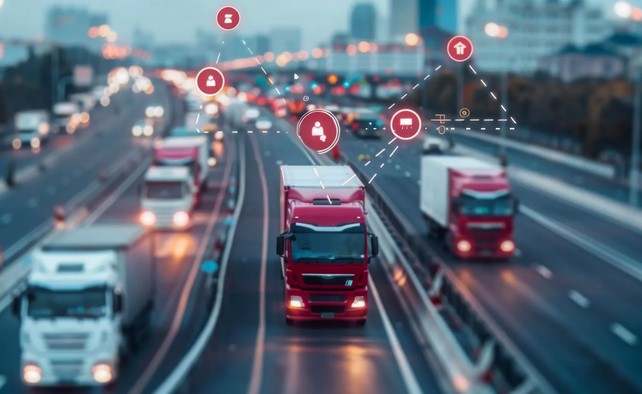
Imagine sitting in a bumper-to-bumper gridlock on a scorching summer afternoon. Your GPS screen turns deep red, adding another 45 minutes to an already exhausting commute. Meanwhile, thousands of miles away, a fleet of autonomous delivery trucks navigates a sudden snowstorm seamlessly, while intelligent traffic control centers alter city light timing in real time to let emergency ambulances glide through congested intersections.
In my over 10 years working across enterprise software architecture and connected health-tech networks, I have witnessed how data moves behind the scenes. Whether managing real-time biometric streams in digital health or tracking telemetry across supply chains, the fundamental goal remains the same: eliminating friction, predicting failures before they happen, and keeping life moving safely.
Today, AI in transportation is no longer a futuristic concept confined to sci-fi films. It is actively redefining urban mobility, global supply chains, and environmental sustainability.
If you are a tech enthusiast, logistics professional, or curious reader eager to understand how machine intelligence is reshaping how people and goods move, this deep-dive guide breaks down the technology, strategies, and real-world mechanics.
1. Demystifying AI in Transportation: The Central Nervous System Analogy
To grasp how AI in transportation transforms transit systems, consider a simple analogy.
Think of a traditional transportation system as an old mechanical clock. Every gear turns on a fixed schedule, blind to whether a storm has hit, an accident has occurred, or a road has collapsed. Artificial intelligence acts as a living central nervous system. It connects eyes (cameras and LiDAR sensors), nerve endings (IoT telematics), and brainpower (predictive algorithms) to adjust the entire system instantly.
                                  +-------------------------------------------------+
                                  |              TRANSPORTATION DATA ENGINE         |
                                  |   (LiDAR, Radar, GPS, IoT Telematics, Traffic Cam) |
                                  +-------------------------------------------------+
                                                           |
                                                           v
       +---------------------------------------------------+---------------------------------------------------+
       |                                                                                                       |
[ SMART URBAN MOBILITY ]                                                                            [ INTELLIGENT LOGISTICS & FREIGHT ]
  - Adaptive Traffic Light Control                                                                    - Predictive Fleet Maintenance
  - AI-Optimized Public Transit Routing                                                               - Dynamic Route Optimization
  - Autonomous & Assistive Vehicles                                                                   - Automated Warehouse Sorting
       |                                                                                                       |
       +---------------------------------------------------+---------------------------------------------------+
                                                           |
                                                           v
                                  +-------------------------------------------------+
                                  |            SMARTER, SAFER & GREENER             |
                                  |               MOBILITY ECOSYSTEM                |
                                  +-------------------------------------------------+
In modern transport networks, artificial intelligence relies on three foundational pillars:
-
Computer Vision and Sensor Fusion: Processing visual data from cameras, radar, and LiDAR (Light Detection and Ranging) to interpret real-world surroundings in milliseconds.
-
Predictive Analytics: Analyzing historical traffic, weather forecasts, and vehicle diagnostic data to forecast delays and maintenance issues.
-
Edge Computing: Running complex neural networks directly inside vehicles and roadside hardware to make split-second safety decisions without relying on slow cloud servers.
2. Revolutionizing Urban Mobility: From Gridlock to Flow
Urban traffic congestion costs global economies hundreds of billions of dollars annually in wasted fuel, lost productivity, and increased healthcare expenditures from pollution.
During my work with connected urban infrastructure, I saw firsthand how legacy traffic light timers fail modern cities. Static green lights turn green for ghost traffic while backing up ambulances three blocks away.
Adaptive Traffic Signals and Smart Corridors
Modern metropolitan areas are deploying computer vision cameras and machine learning models at intersections.
-
Rather than relying on fixed timers, adaptive traffic control systems analyze approaching vehicle volumes, pedestrian foot traffic, and vehicle speed.
-
The algorithms dynamically adjust green light durations in real time, reducing urban intersection delays by up to 25% and curbing unnecessary idle emissions.
Autonomous Vehicles and ADAS Technologies
While fully driverless passenger cars are still navigating regulatory approvals in many markets, Advanced Driver Assistance Systems (ADAS) powered by deep learning are already saving lives daily.
-
Features like automated emergency braking, lane-keeping assistance, and blind-spot detection rely on convolutional neural networks (CNNs) trained on millions of driving hours.
-
These systems act as a second set of eyes, compensating for human distraction and fatigue.
Pro Tip from the Field: If you are managing municipal transit or fleet deployments, do not try to overhaul your physical fleet overnight. Focus first on upgrading your telematic data integration. Installing smart edge gateways on existing vehicles provides instant visibility and immediate fuel-efficiency gains before investing in fully autonomous hardware.
3. Transforming Supply Chains: Intelligent Logistics and Freight
While self-driving cars capture headlines, the real quiet revolution of AI in transportation is taking place across global supply chains and freight hubs.
+------------------------------------+------------------------------------+------------------------------------+
| Application Area                   | Core AI Technology                 | Primary Business Impact            |
+------------------------------------+------------------------------------+------------------------------------+
| Predictive Vehicle Maintenance     | Telematics & Anomaly Detection     | Prevents roadside breakdowns       |
| Dynamic Route Optimization         | Reinforcement Learning Algorithms  | Cuts fuel usage & transit times    |
| Automated Warehouse Logistics      | Computer Vision & Robotics         | Accelerates order fulfillment      |
| Demand & Capacity Forecasting      | Time-Series Machine Learning Models| Optimizes cargo container usage   |
+------------------------------------+------------------------------------+------------------------------------+
Predictive Maintenance: Stop Fixing, Start Preventing
Few things wreck a supply chain faster than an enterprise semi-truck breaking down on a highway with a trailer full of temperature-sensitive medical cargo.
-
Traditional maintenance relies on arbitrary mileage milestones (e.g., changing oil every 10,000 miles).
-
AI-driven predictive maintenance monitors engine telemetry, vibration sensors, transmission fluid heat, and battery voltage in real time.
-
Machine learning algorithms spot microscopic anomalies in component performance weeks before a physical breakdown occurs, allowing technicians to schedule fixes during routine downtime.
Dynamic Route Optimization
Legacy navigation apps simply calculate the shortest distance between points A and B. Enterprise logistics models go far beyond static maps.
-
AI route optimization engines continuously evaluate real-time weather alerts, toll pricing, historical border check delays, vehicle weight restrictions, and fuel consumption profiles.
-
By rerouting delivery fleets dynamically around emerging bottlenecks, logistics providers save millions of gallons of diesel fuel annually while meeting tight delivery windows.
4. Building an AI-Driven Transport Strategy: Step-by-Step
Transitioning legacy transit or corporate transport operations toward intelligent automation requires a structured roadmap.
Here is the operational framework I recommend when implementing systems driven by AI in transportation.
       [ STEP 1 ]                 [ STEP 2 ]                 [ STEP 3 ]                 [ STEP 4 ]
  Establish Data Pipelines    Deploy Predictive Models     Implement Edge Processing   Maintain Human-in-the-Loop
 (IoT Telematics & Sensors)   (Route & Maintenance AI)     (On-Vehicle Processing)      (Safety & Oversight)
Step 1: Establish High-Quality Data Pipelines
AI algorithms require accurate, continuous inputs. If your vehicle sensors produce noisy or delayed telemetry data, your machine learning models will generate flawed predictions.
-
Standardize onboard diagnostic (OBD-II) readers, GPS tracking, and temperature sensors across all fleet assets.
-
Secure data transmission pipelines using enterprise-grade encryption to protect against telemetry tampering.
Step 2: Deploy Targeted Predictive Analytics
Begin with focused operational problems that yield clear return on investment (ROI).
-
Deploy predictive maintenance models to fleet vehicles with the highest operational costs.
-
Use time-series forecasting models to optimize driver scheduling and reduce overtime expenses.
Step 3: Implement Edge Processing for Real-Time Safety
For safety-critical applications like collision avoidance or sudden obstacles, waiting for data to travel to a cloud server and back takes too long.
-
Deploy edge-computing hardware inside vehicles and at roadside units to execute inference models locally within milliseconds.
Step 4: Maintain Human-in-the-Loop Oversight
AI is designed to augment human decision-making, not replace human judgment entirely.
-
Establish centralized command centers where human dispatchers and safety officers monitor AI recommendations and override automated decisions during complex emergencies.
5. The Hidden Warning: The Cybersecurity Trap in Connected Transit
Connecting vehicles, streetlights, and warehouses to central neural networks creates incredible efficiency—but it also dramatically expands your cyber attack surface.
During my years in enterprise technology, I have seen organizations rush to deploy smart IoT devices while overlooking basic firmware security.
Hidden Warning: A connected vehicle is essentially a high-speed computer on wheels. If an enterprise fleet management system lacks rigorous API authentication and network segmentation, bad actors can exploit vulnerable telematics units to access sensitive GPS tracking logs, manipulate route data, or even interfere with vehicle control systems. Always enforce strict zero-trust architecture across all connected transport nodes.
Summary: Steering Toward a Smarter Future
The integration of AI in transportation is fundamental to building sustainable, efficient, and resilient societies. By transforming static road networks and shipping lanes into adaptive, data-driven ecosystems, artificial intelligence empowers us to move people and goods faster, safer, and with a significantly lower carbon footprint.
Key Takeaways for Business Leaders and Innovators:
-
Embrace Predictive Thinking: Move from reactive repairs and static scheduling to proactive, AI-driven forecasting.
-
Prioritize Edge Infrastructure: Run critical safety and computer vision models directly on hardware at the vehicle or intersection level.
-
Optimize the Supply Chain: Use dynamic routing and automated asset monitoring to lower fuel costs and prevent shipping delays.
-
Secure Connected Assets: Treat telematics units and smart road sensors as critical enterprise network endpoints requiring zero-trust security.
-
Keep Humans in the Loop: Pair automated intelligence with human oversight to ensure safety and operational flexibility.
What Is Your Vision for Smart Mobility?
How do you see AI transforming your daily commute or corporate logistics operations in the coming years? Are you excited about autonomous freight fleets, or looking forward to smart cities that eliminate traffic jams?
Share your thoughts, questions, or real-world experiences in the comments below—let’s discuss how we can build the future of mobility together!

Comments are closed.